Case Study — Michael Angeles
Klarita.
0→1 product design. Solo build. Claude Code and React.
Role
Solo Designer & Developer
Stack
React, Claude Code
Timeline
2026
Status
Live at klarita.app
The Context
Building got cheap. Deciding what to build got expensive.
AI took the friction out of making things. I can go from a sentence to a working prototype in an afternoon. That speed has a cost. It is now easy to build the wrong thing fast and make it look finished. A polished prototype of the wrong idea still costs you the week.
Klarita product
The Problem
Design starts too late.
By the time you open a design tool, the decisions that matter most are already made. The biggest ones come first: what problem to solve, who to solve it for, and what success looks like. In most teams those get decided in scattered docs and half-remembered conversations, or they get skipped.
I’d felt this gap repeatedly across my own work and in observing teams around me. There was no dedicated tool for the messy, ambiguous phase before execution time, and AI made it the right moment to build one.
I was the founding designer at Balsamiq, a tool 1.4M people use to think before they build, and I wrote a book on wireframing. This is the problem I’ve spent my career closest to.
Michael Angeles — Founding Designer, Balsamiq
The Product
A place to think before the canvas.
01
Dump the mess
Start by writing whatever is in your head. Klarita reads it and pulls out the problems, users, constraints, and assumptions hiding in the text.
02
Work through three phases
Explore, Define, Design. Short activities with AI help at every step, each one feeding the final spec.
03
Leave with a brief
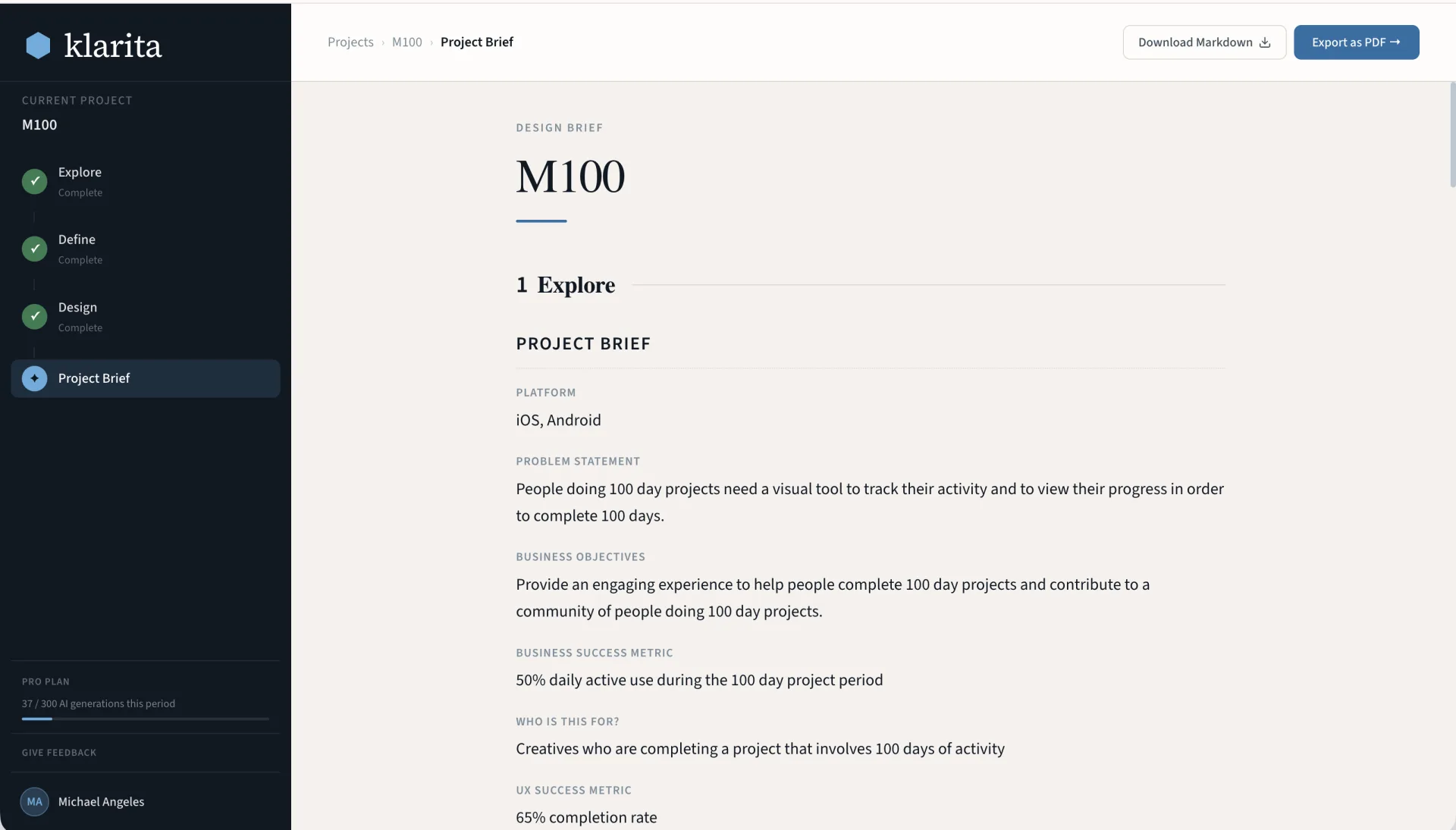
Everything compiles into one shareable document, exported as PDF or Markdown.
04
Carry it into the build
The brief becomes a CLAUDE.md plan that drops straight into Claude Code. The thinking survives the handoff.
Decision 01 — The Way In
Two doors in.
Brain Dump — the default

Write freely. Klarita extracts typed cards for problems, goals, users, and constraints, each flagged with a confidence level, and seeds the brief from them. You curate; it organizes.

Wizard — the structured path

Step-by-step activities in order, for the times you already know the shape of the problem and want the rails.

I made the messy door the default. Discovery rarely starts organized, and a blank form is where thinking stalls.
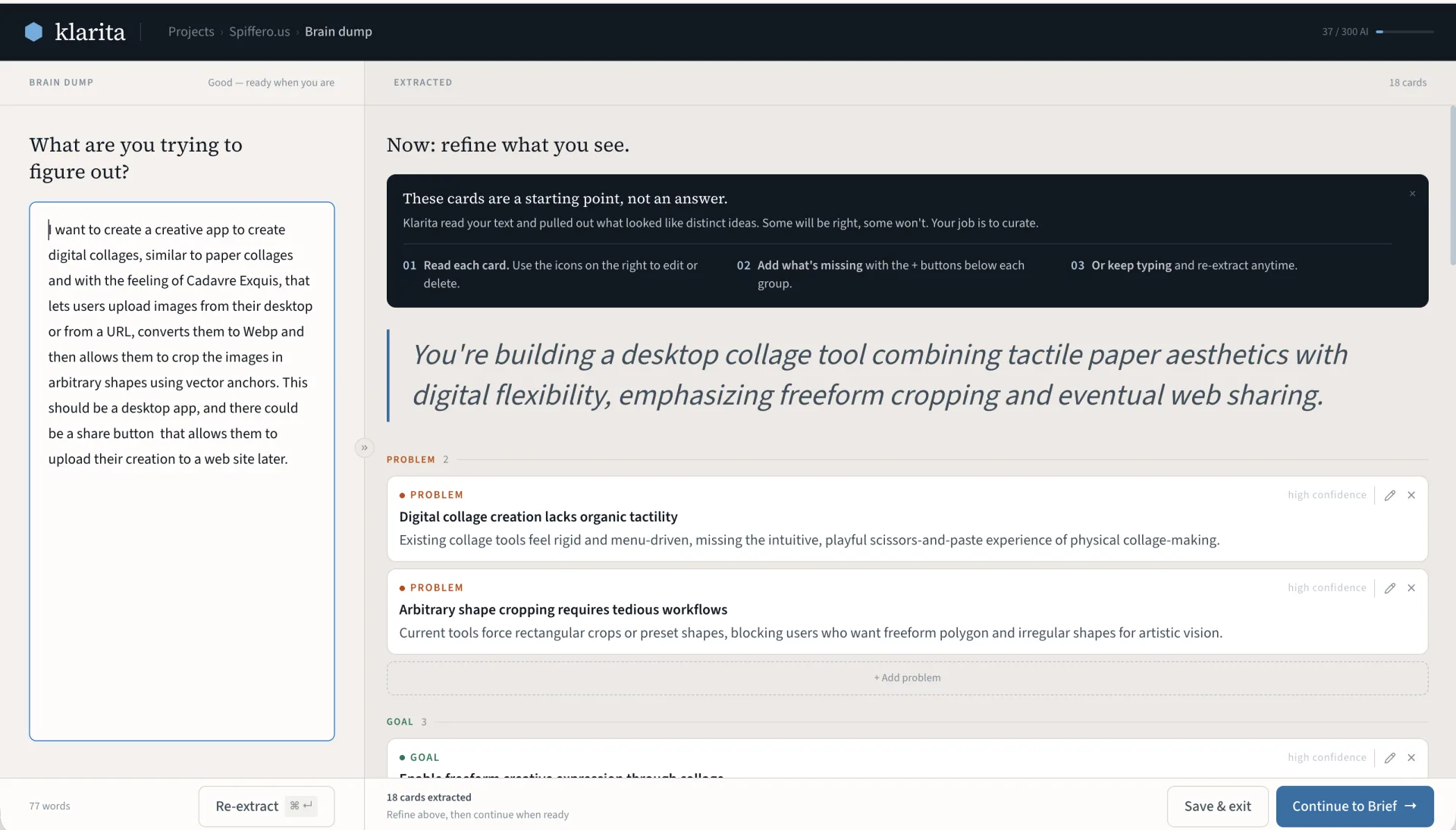
Brain Dump with extracted cards
Decision 02 — The Method
Every activity feeds the brief.
01
Explore
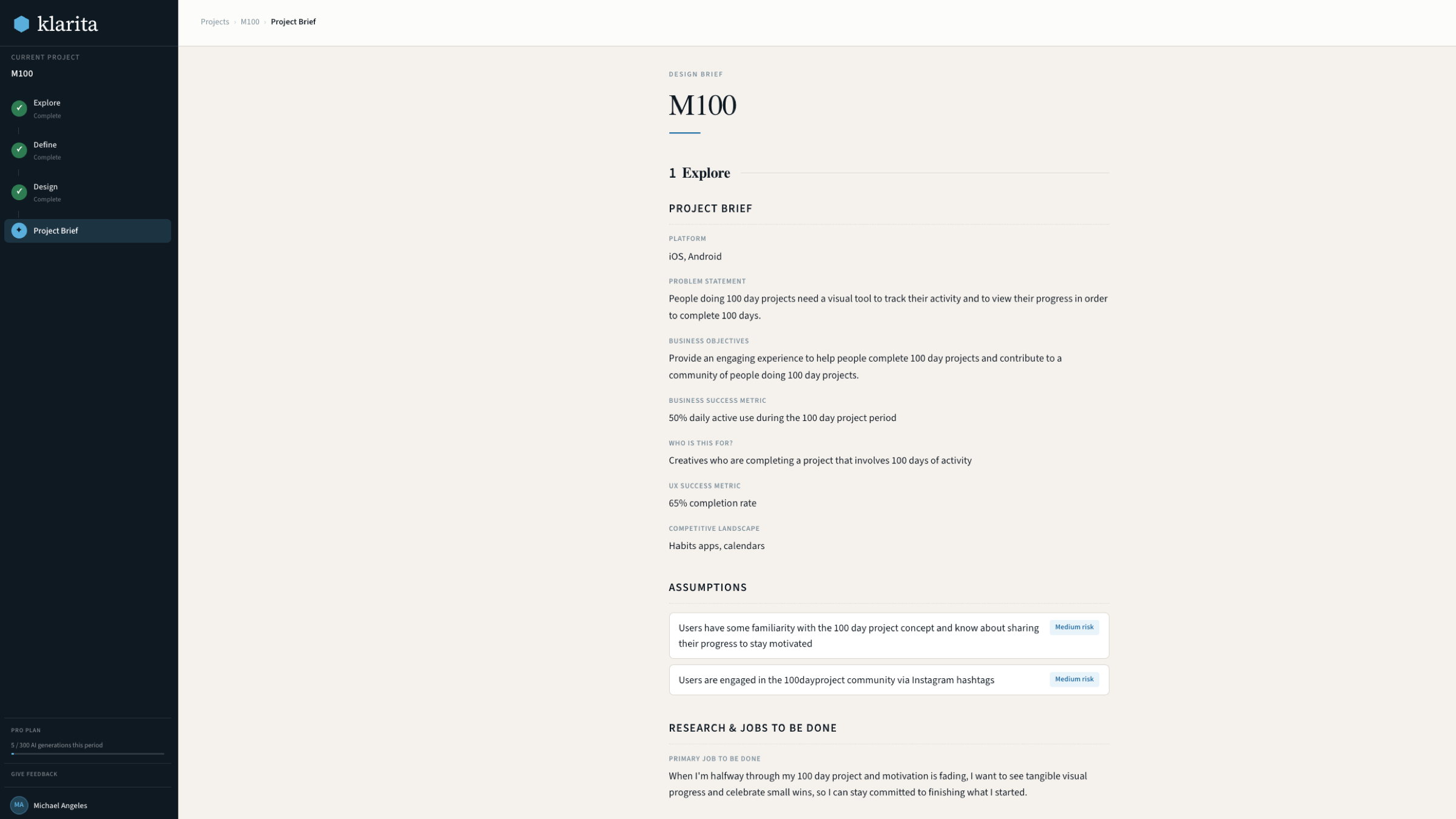
Project brief, assumptions rated by risk, research and jobs-to-be-done, user overview. Open the problem before solving anything.
02
Define
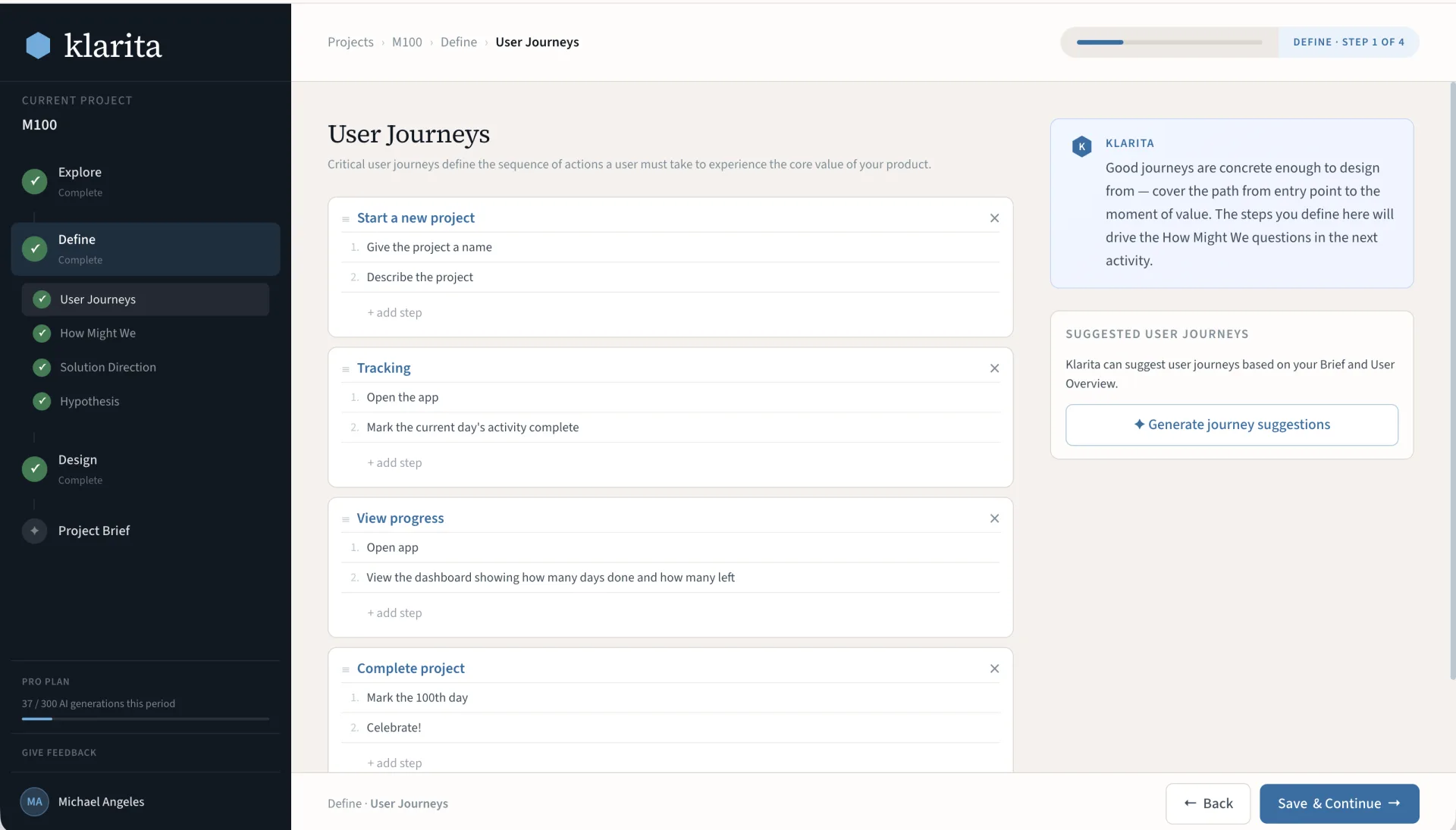
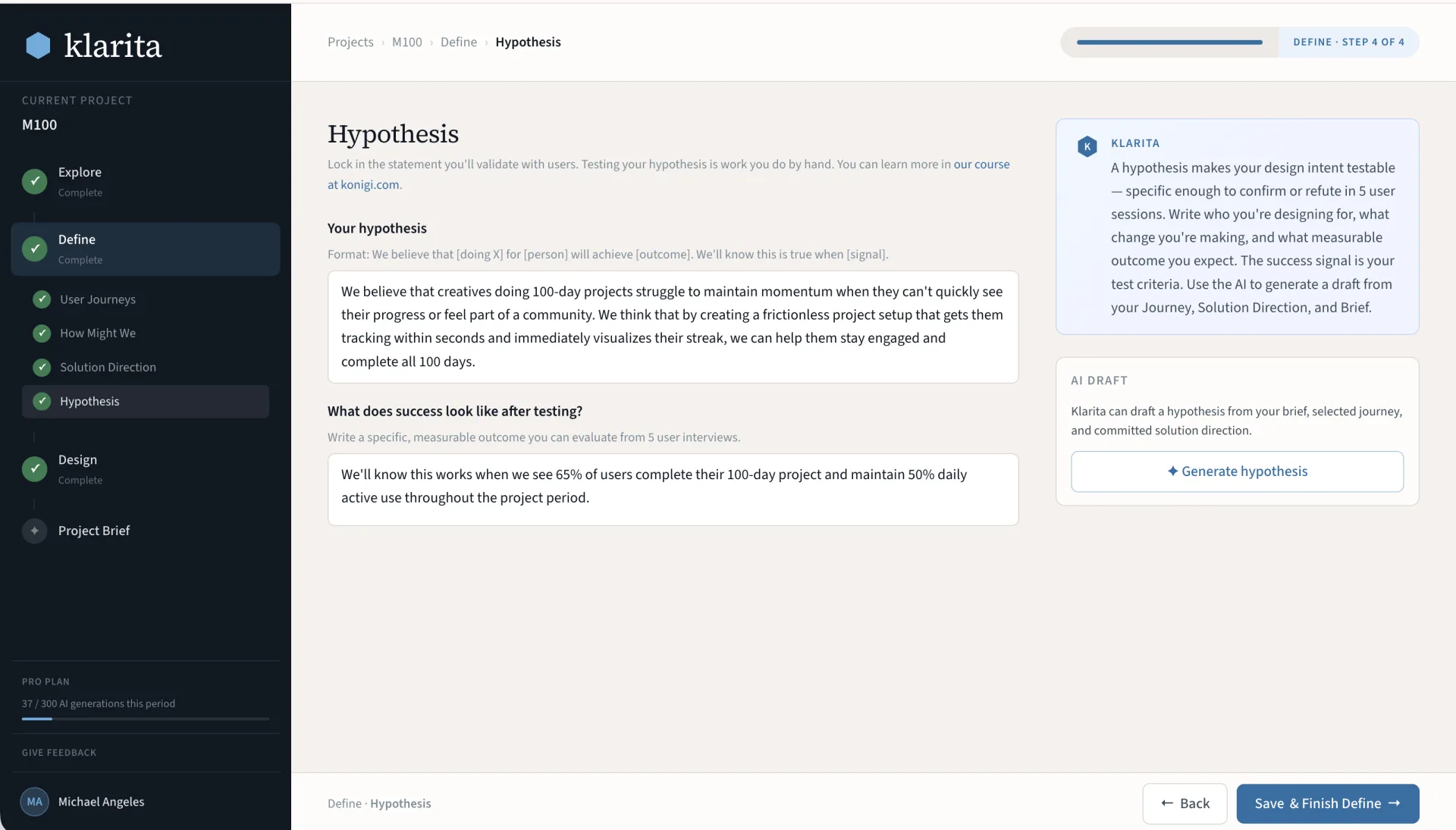
User journeys, How Might We with voting, a committed direction, and a testable hypothesis: we believe doing X for Y will achieve Z.
03
Design
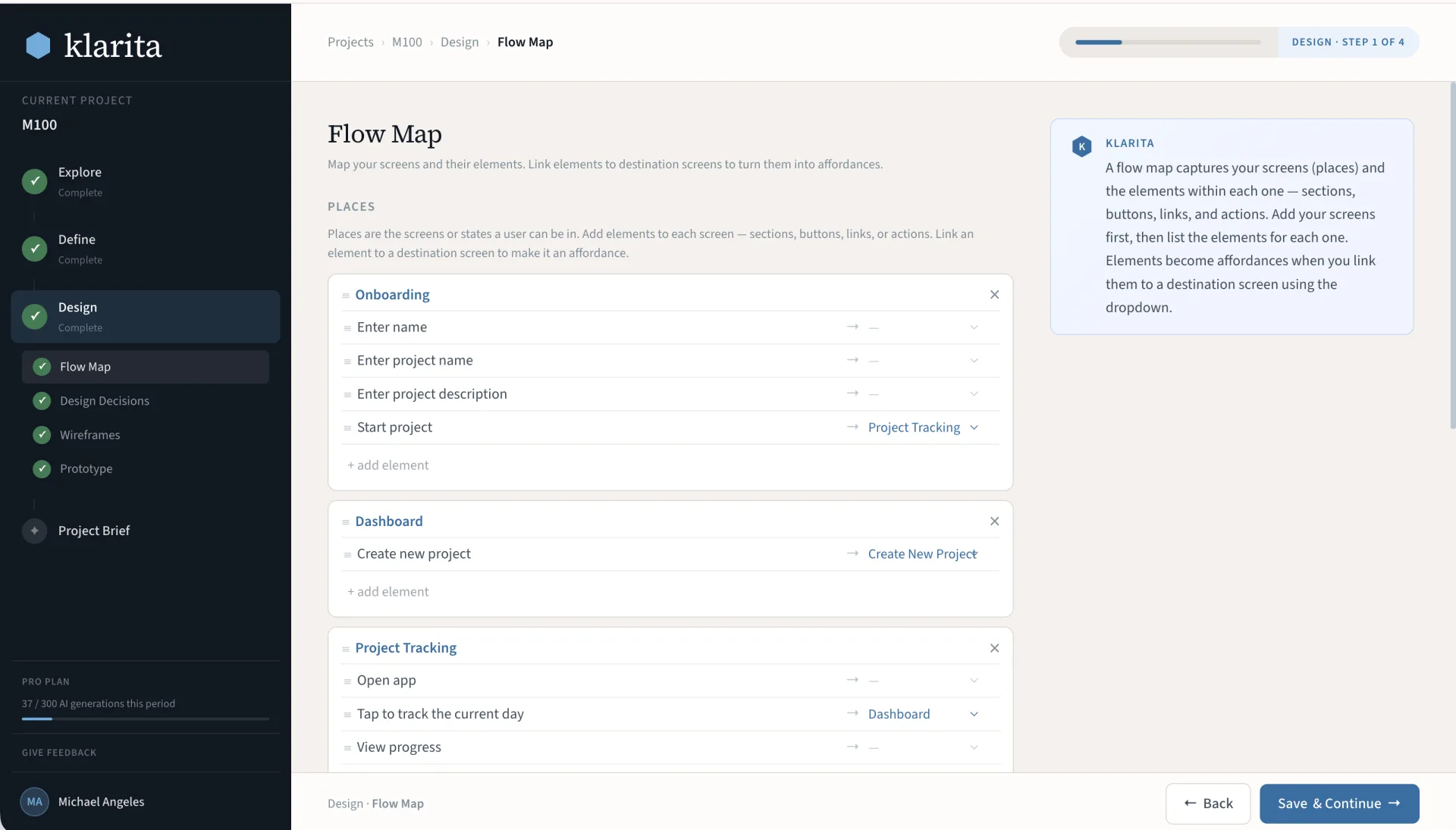
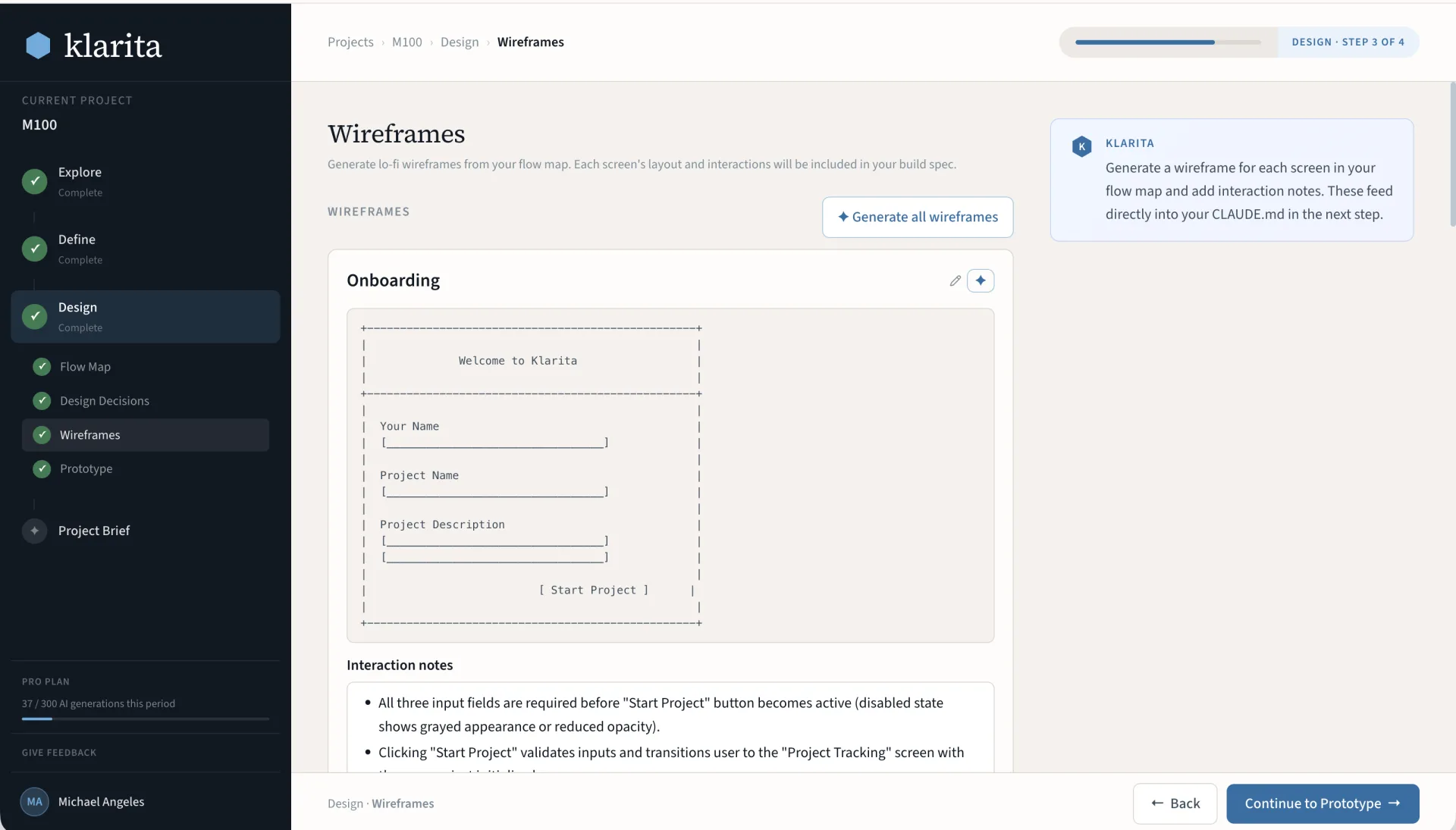
Flow map, design decisions, lo-fi wireframes. The spec half of the sprint is prepped and ready to hand to whoever builds.
I worked backwards from the artifact. If an activity didn’t feed a section of the final brief, it got cut.
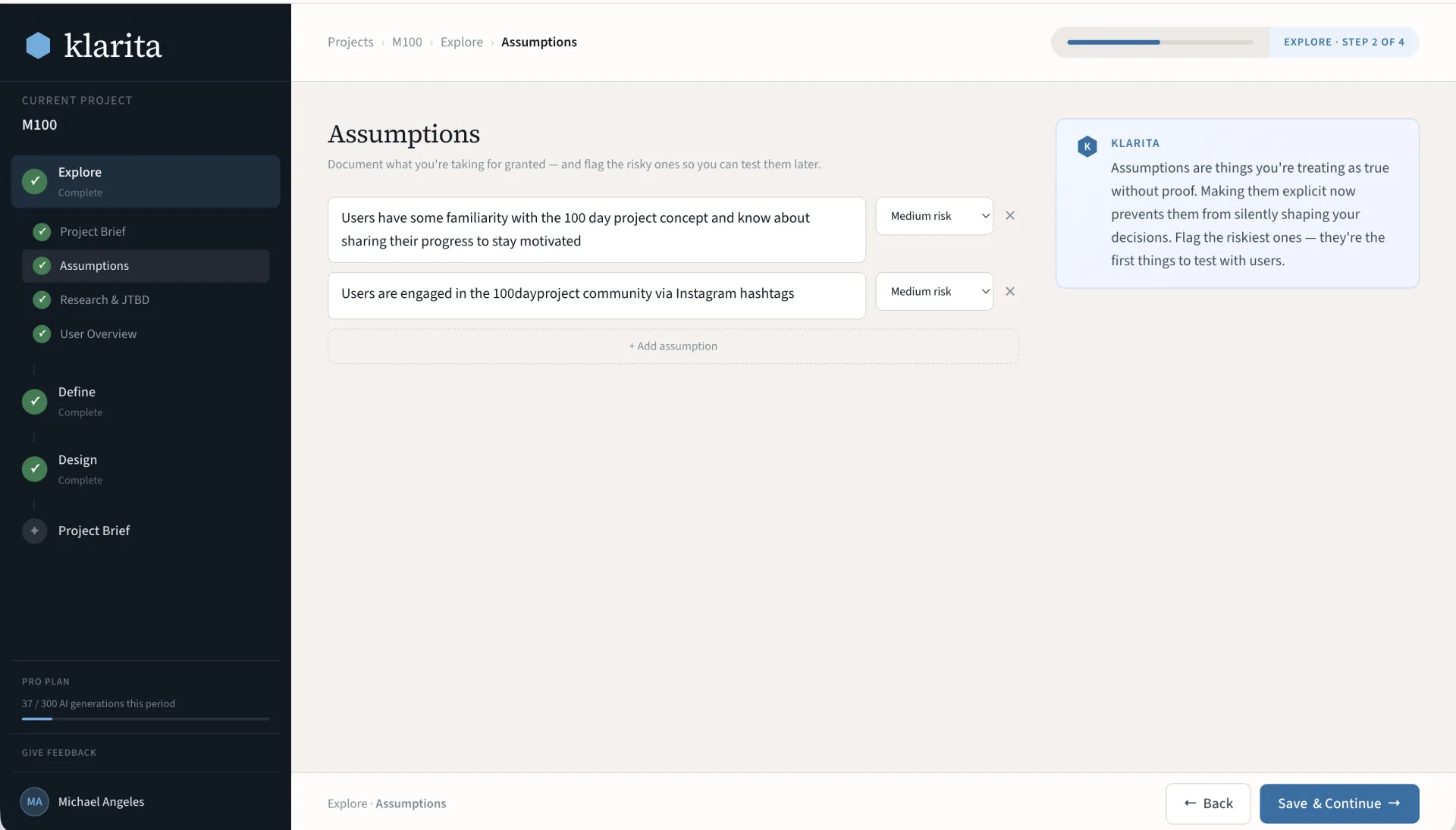
Decision 03 — The AI
AI that suggests, never writes.
01
Suggestions live in a side panel
AI output lands next to your work, not in it. You review, edit, and move it over yourself. Nothing is applied automatically.
02
One model, behind the server
Every AI feature runs a single model through a serverless function with plan-aware limits. The key never touches the client.
03
Twelve evals keep it honest
Automated checks on every AI function, so a prompt tweak can’t quietly degrade what users get.
The brief has to stay the user’s thinking. The moment AI writes it for them, they stop trusting it—and stop reading it.
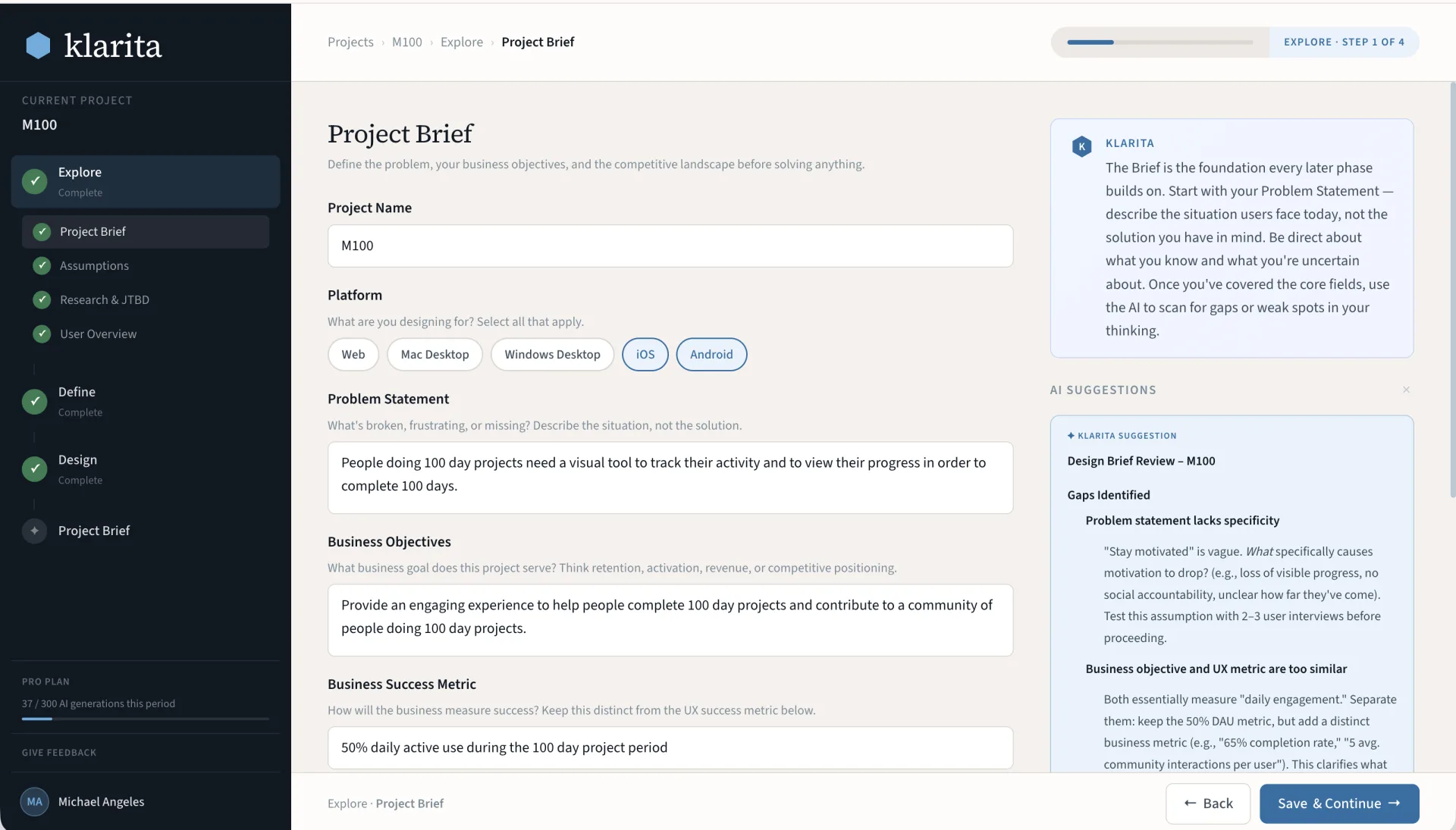
AI suggestions panel reviewing the brief
Decision 04 — The Handoff
The brief becomes the build.
01
A CLAUDE.md, not only a PDF
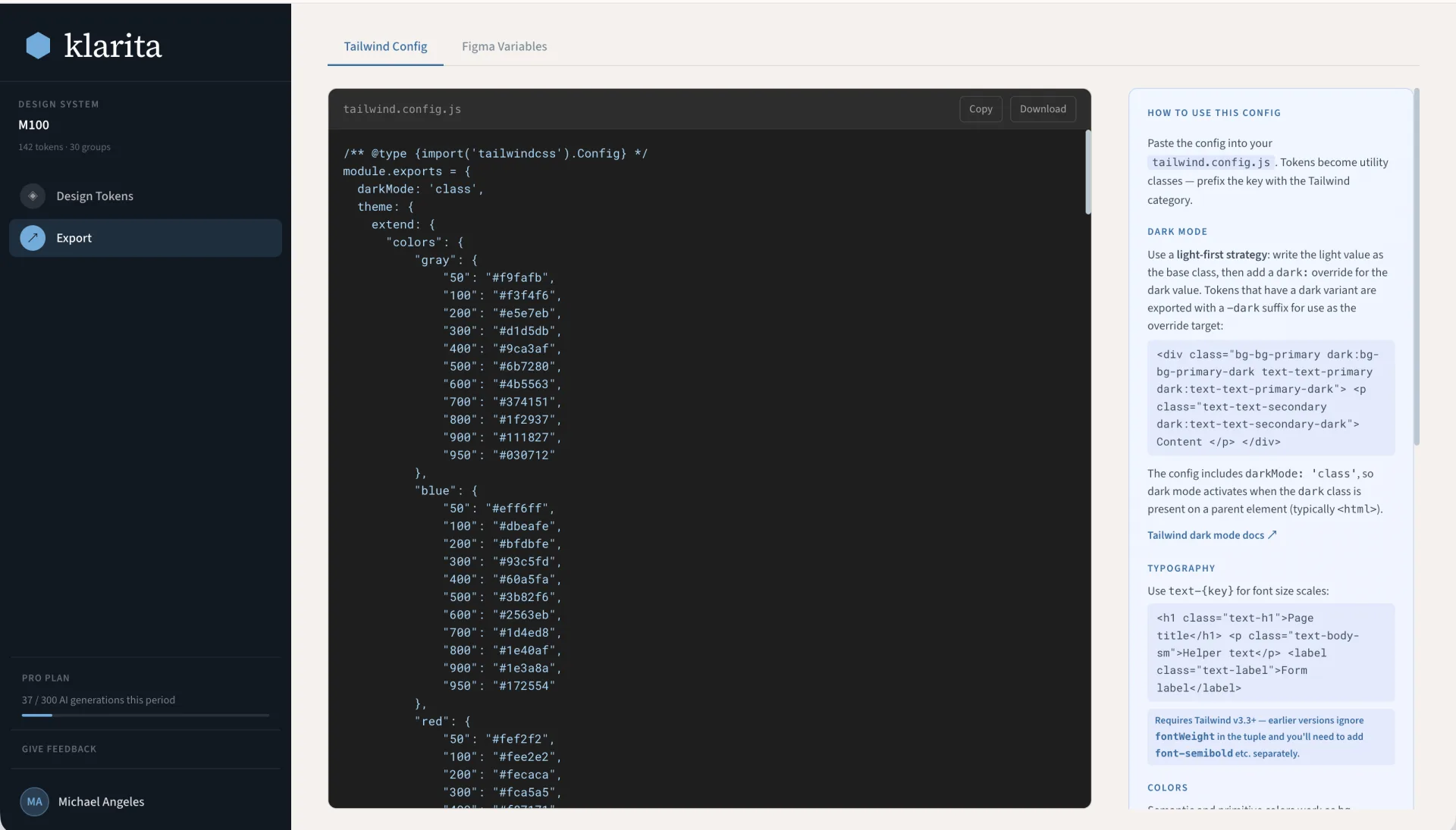
Klarita generates a working plan for Claude Code, backed by a library of 115 design.md brand templates.
02
Design tokens ride along
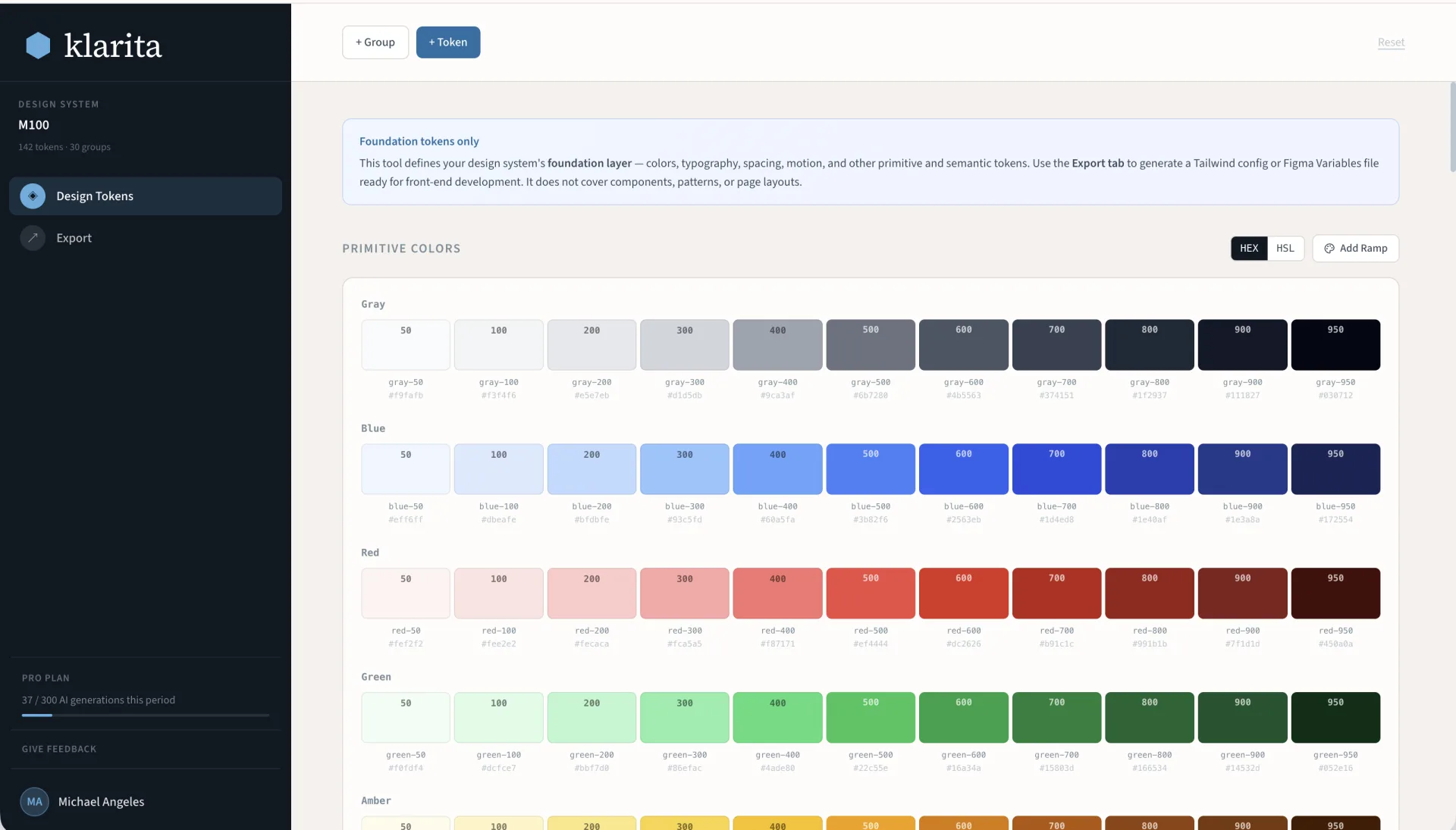
A companion Design System tool defines your foundations as tokens, then exports a Tailwind config or Figma Variables.
03
Pick your builder
The handoff targets Claude Code, Bolt, or v0, so the thinking starts a prototype instead of landing in a folder nobody opens.
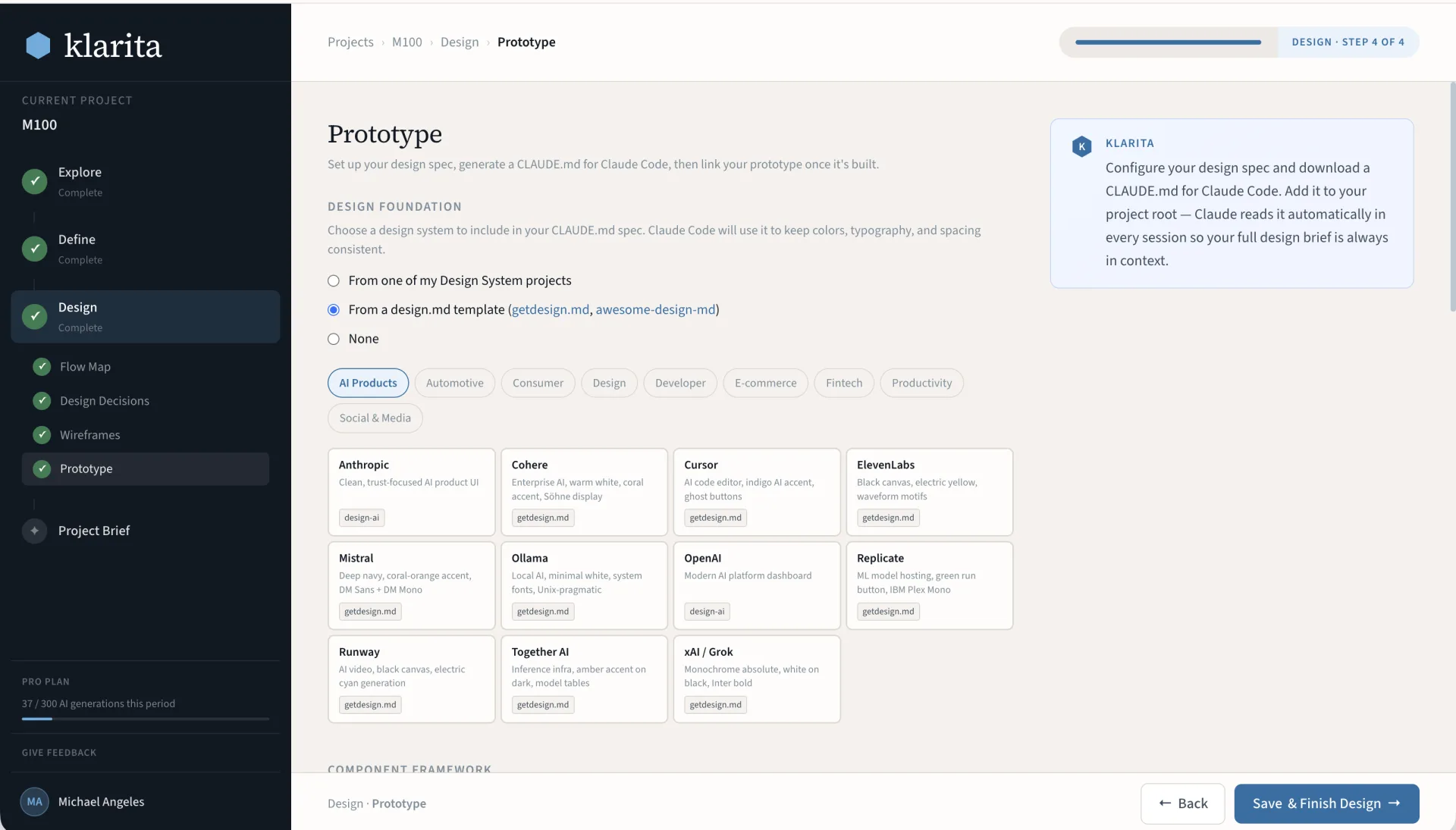
What I said no to
01
Not a project-management tool.
The Call

Klarita ends at the brief and the handoff. No tasks, no boards, no timelines.

The Cost

A smaller product, without the daily-use stickiness a PM suite gets for free.

Why Anyway

The moment it manages work it competes with tools people already live in. Holding the line at discovery kept it shippable, and kept it good at one thing.

02
No Test phase in the app.
The Call

The sprint stops at a testable hypothesis and a spec. Validation happens with real users, by hand.

The Cost

The methodology looks incomplete next to tools that promise end-to-end everything.

Why Anyway

In-app “testing” would be theater. I’d rather hand you a sharp hypothesis and point you at five real interviews.

03
Priced for one person.
The Call

Free for two projects. Pro is $7 a month. Built for solo designers, PMs, and consultants first.

The Cost

A hard ceiling on revenue per account, and no enterprise story yet.

Why Anyway

The people who feel this pain most work alone. Structure shouldn’t be a team-size privilege.

Three nos, one principle.

A small tool that does the thinking phase well beats a big tool that does everything. Scope discipline is what made it shippable.

Current State
Live now. Validation is the next chapter.
Klarita is live. I built it solo, from the first sketch to the running product. I haven’t put it in front of users at scale, and that’s the honest next step: get it into designers’ hands and let their real use reshape it.
I built it to show I can see a problem, frame it before building, and ship the answer on my own. That’s the work I want to do for a team.
Next: validate with real users at scale
What Klarita shows.
0→1, end to end
I saw a problem I’d lived with for years, framed it before building, and shipped the answer alone: vision, research, UX, UI, and production code.
AI product judgment
I decided where AI helps and where it stays out, then enforced that with guardrails and evals. The suggestion panel is a design position, not a feature checkbox.
Design to build, one person
Klarita was designed and built in the same agentic workflow it hands off to. Design and engineering never drifted apart, because they were the same loop.
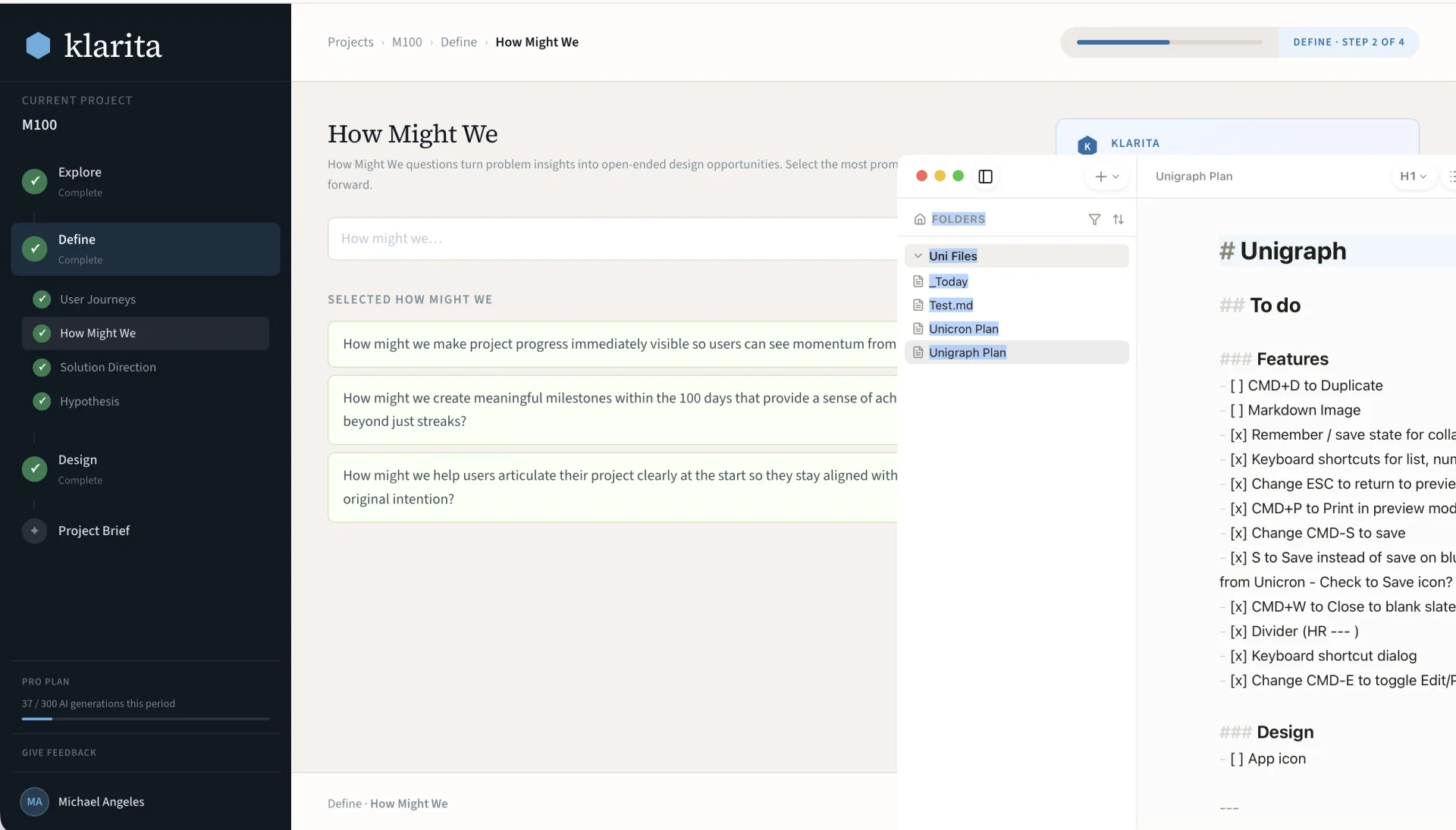
Brain dump
Assumptions
User journeys
How might we
Flow map
Wireframes
Prototype handoff
Design tokens
1 / 8
Case Study — Michael Angeles
Thank you.
Interested in seeing more work, process, and background?
View Full Portfolio → Browse Media Gallery →