Scaling design quality across the team
Summary

I was Balsamiq’s founding designer, and over fifteen years I grew design from a one-person practice into a function the whole company could draw on: playbooks the team used daily, a design system spanning web, Mac, and Windows, individualized mentorship, and a suite of custom GPTs that put expert design guidance on tap.
The Challenge
How do you scale design quality across a distributed team when you’re the founding designer and the design culture lives in your head?
After years as the sole designer at Balsamiq, the company was growing and I needed to transition from doing the design work to enabling others to design in code and do it well. The challenge was to build the systems, documentation, and culture that would let design quality scale without me being the bottleneck.
At the same time, AI was opening new ways to amplify the team. Beyond a traditional design operations function, I wanted AI-augmented design ops that could scale expertise in ways that weren’t possible before.
Systems & Playbooks
I created the documentation and standards that turned implicit knowledge into a shared design language.
I built product design playbooks covering our design philosophy, process, and quality standards, and the team referenced them daily for everything from how we run design critiques to our standards for interaction patterns across platforms.
The design system guidelines I established defined standards for typography, color, iconography, spacing, and component patterns across Web, Mac, and Windows.
Playbooks over process mandates
Instead of rigid processes, I created reference guides that explained the why behind design decisions. Team members could adapt to context while maintaining quality because they understood the principles, not just the rules.
Design system as shared vocabulary
The component library and pattern guidelines gave every team member the same vocabulary and quality bar, which cut ambiguity and sped up design decisions across three platforms at once.
AI-Powered Design Ops
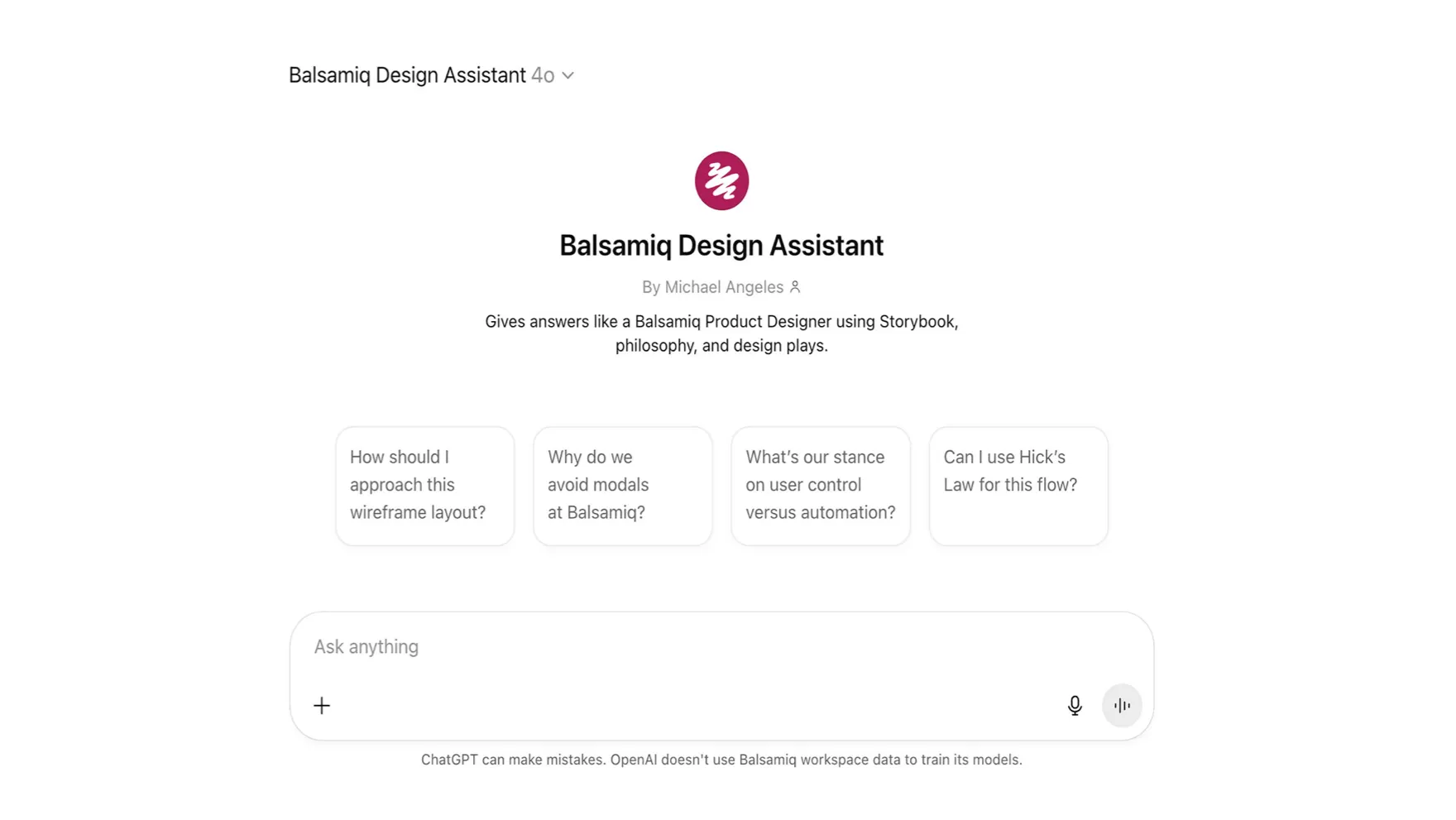
The self-service design assistant, answering questions I used to field in review meetings
I built custom GPTs that put expert design guidance on tap for the whole team, back when custom assistants were still a novelty.
Each assistant in the suite was trained on our design philosophy, design system, and practices, and customized to Balsamiq’s context with what I learned co-authoring "Wireframing for Everyone."
Custom GPT toolkit
Design assistant
Trained on our philosophy and design system. Team members could get guidance on component usage, pattern decisions, and design rationale without waiting for a review meeting.
Design critique facilitator
Structured critique sessions with prompts based on our quality standards. Helped team members give and receive better design feedback consistently.
Shape Up pitch generator
Helped PMs and designers write better pitches by encoding our Shape Up process. Reduced the time to produce well-structured feature proposals.
Mentorship & Growth
Scaling design quality ultimately means growing the people doing the work.
The team I was coaching was small, which made the mentorship deep rather than broad: one product manager and one UX researcher, each with an individualized growth framework built from structured skill assessments and personalized coaching. I identified each person’s strengths and blind spots, then created targeted learning paths that built on what they already did well, rolled up into a UX Skills Map showing the path to improvement. The product manager I mentored was promoted to manager.
The UX learning tools I built gave team members self-serve access to expert-level guidance, so they could learn and improve continuously instead of only during scheduled mentoring sessions.
What the Team Says
The honest measure of this work is what the people I supported say about it.
"Working with Mike genuinely changed how I think about design. He didn't just do great work—he made the work better for everyone around him."
"He helped push our company forward in AI long before it was popular, with early experiments that shifted our roadmap and strategy."
"He showed me ways I could apply design thinking to developing administrative, HR, and operations practices and procedures."
The Approach in Practice
Reflection
What 15 years of building a design function taught me about leadership.
Culture scales through systems
When design quality lives only in one person’s head, it doesn’t scale. Playbooks, design systems, and AI tools turned implicit knowledge into shared infrastructure that worked whether I was in the room or not.
AI amplifies mentorship
Custom GPTs extended human coaching: team members could get guidance at 2 AM, or iterate on a pitch before bringing it to review. The AI raised the floor and freed me to work on the ceiling.
Lead by doing
The most effective way to establish design standards was to demonstrate them in my own work. Staying hands-on as an IC while leading the team meant the playbooks reflected real practice, not theory.
Founding designer is a unique role
Building a design function from scratch in an engineering-driven organization requires a different skillset than joining an established team. You’re simultaneously defining what good design looks like, doing the work, and building the systems that will eventually let others do it too.
I spent fifteen years trying to make myself less necessary. The playbooks, the design system, and the GPT assistants all point the same direction: the team holds quality and velocity whether I’m in the room or not. I’d argue that’s what scaling design actually means.
Project Details
Previous Case Study
← Turning personal knowledge into actionNext Case Study
Designing Balsamiq’s AI wireframing experience →