Taking a product from idea to the App Store
Summary
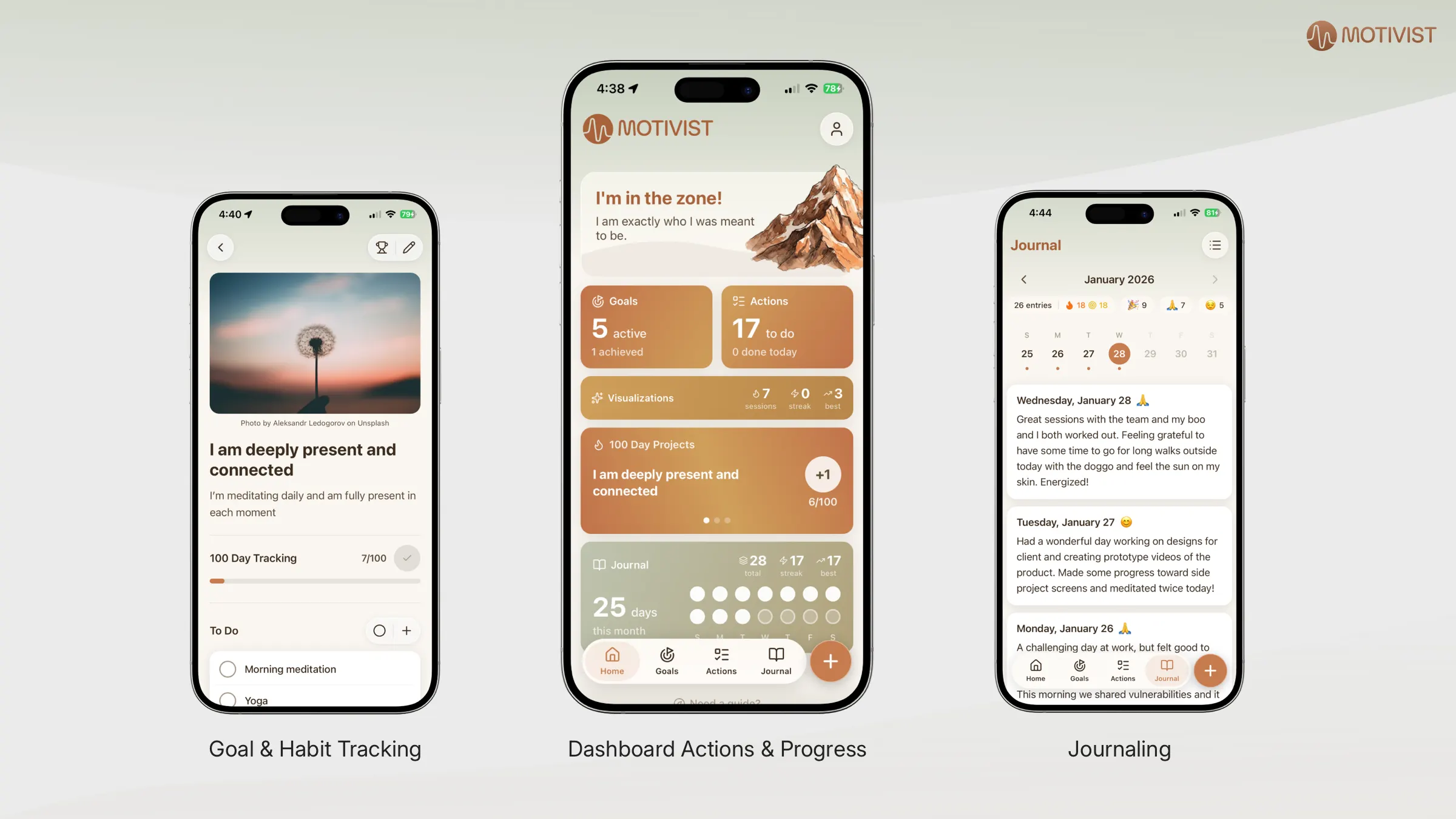
Motivist is a goal and habit-tracking iOS app for people with ADHD that I took from first sketch to App Store submission in eight weeks, solo. I handled the product strategy, UX and UI, React Native development, and the launch, with Claude Code as the development partner. It’s live on the App Store, and I’ve been iterating on it with real user feedback since.
The Problem
I'd tried dozens of goal and habit apps and kept hitting the same wall: habit trackers didn't connect to larger goals, and goal-setting tools felt like project management software. They treat goals as todo items and habits as streaks, and miss the connection between the two.
For a neurodivergent brain the failure mode is sharper. Generic systems don't stick. What works is visual and motivating, breaks a big goal into small activities you can actually finish, and stays simple enough to open every day. None of the apps I tried managed all of that at once.
Rather than wait for someone else to build it, I decided to design and ship it myself, using AI-assisted development to move at a pace that would have been impossible for a solo designer a few years ago.
The Process
I wore every hat: researcher, designer, developer, and product manager. The key was using AI tools to compress timelines without cutting corners on design quality.
I started by auditing the competition, mapping each app's strengths and blind spots to find where Motivist could carve out a distinct position. The insight: most were strong on either habit tracking or goal setting, but none bridged them with a visual, motivating interface that helped people identify and focus on small steps every day.
AI-Assisted Workflow
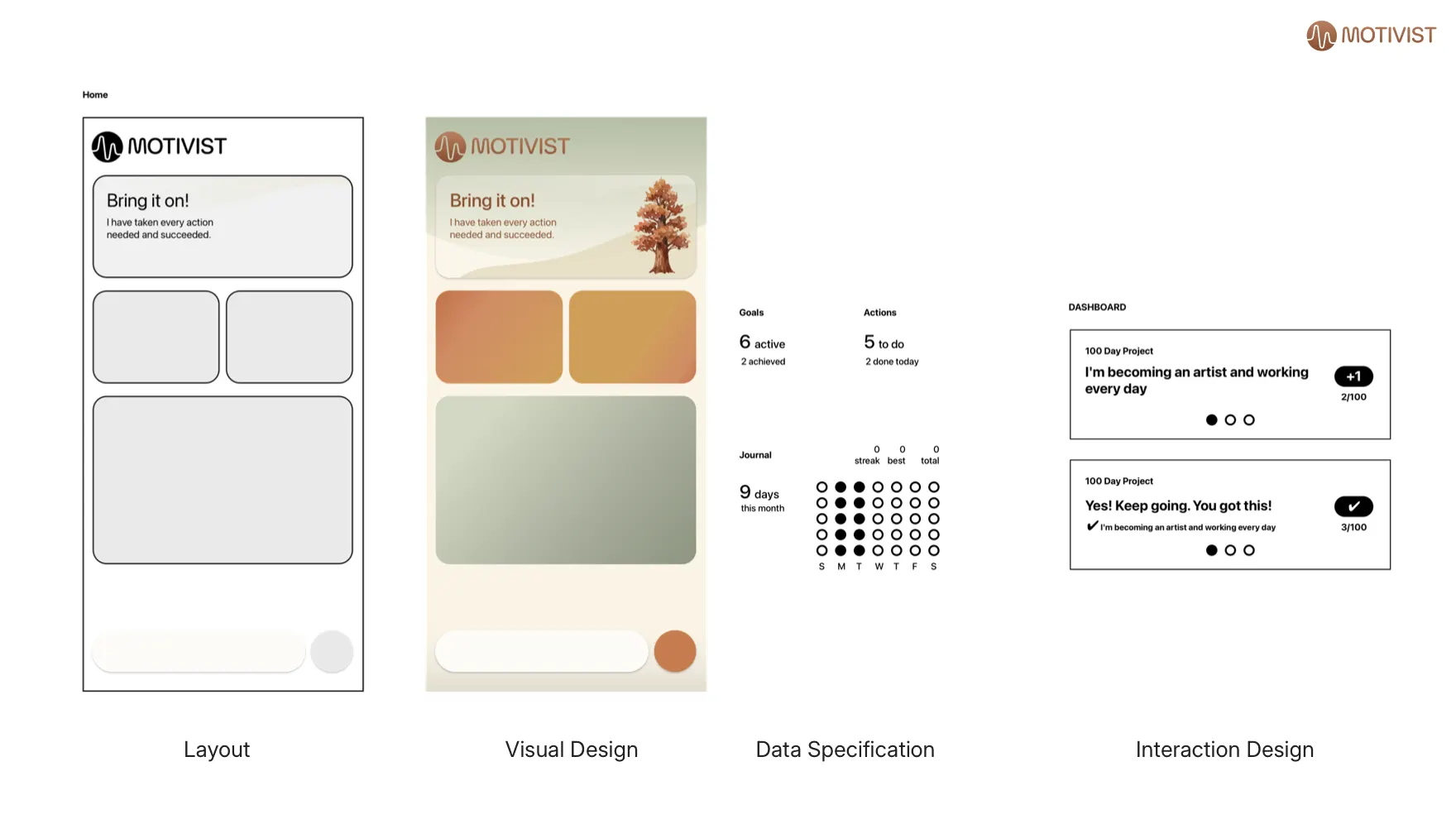
AI here was a development accelerator: it did the building while I did the design, and that division of labor is what let one person ship a real product.
Acting as design director with Claude Code as the developer, I sprinted on features in hours and built Claude skills for planning, design-system maintenance, documentation, and testing. Direction occasionally needed a minimal artifact, and I ran the cycles the way you would an Agile or Lean project. The comp above was the only visual produced for design, other than production graphics for the logo and the illustration on the home screen.
How Claude Code changed my process
More directions, faster
Instead of committing to one approach early, I used Claude Code to rapidly explore multiple interaction patterns and data models. I tested 3-4x more concepts than I could have alone.
Functional prototypes, not mockups
Every prototype was working code. I could test with actual data, real device interactions, and genuine user flows, not just click-through mockups.
Design decisions in code
My prompts to Claude were rarely "write this code." More often it was "here's the UX problem, here are the constraints, what approaches should we consider?"
Key Decisions
Four calls shaped what Motivist became at launch.
Goals and habits on one dashboard
Apps often separate these into different views. I put them together so the user can see how daily habits connect to larger goals. This added complexity to the UI, but the user insight was clear: motivation comes from seeing progress and the path forward.
Visual customization as motivation
Colors, photos, rotating prompts and messaging, and personal reminders aren't just decoration. They're what make a tracker feel like yours. I invested design time in customization features that most MVP advice would say to cut.
Progress estimation over streak counting
Streaks punish you for missing a day. I designed progress tracking around cumulative progress and forgiving messaging, so a single missed day doesn't feel like failure.
Free for 3 goals, premium for more
The pricing model was a product design decision for growth, not just a business one. Three goals is enough to be genuinely useful. The upgrade feels like expansion, not unlocking basic functionality.
The Craft Up Close
Reflection
I've built multiple projects with generative code. Here's what building a solo product for the App Store taught me about building and shipping with AI tools.
AI is a thinking partner, not a magic wand
The best results came from treating Claude Code as a collaborator, not an order-taker. Strategic planning and iterative conversation produce far better outcomes than one-shot requests.
Design judgment can't be automated
AI accelerated the building, but every meaningful decision about what to build, what to cut, and how to handle edge cases came from design experience.
Shipping is a skill
Knowing when to stop iterating and actually release is its own discipline. The temptation with AI speed is to keep adding features. The discipline is knowing when the product is ready for real users.
User feedback changes everything
What I thought users wanted and what they actually responded to were different lists. Real-world test feedback and reviews surfaced priorities I hadn't anticipated.
A senior designer with AI tools can now ship what used to take a small team, and a designer who can operate this way brings a different kind of value to any team they join.
Project Details
Previous Case Study
← From customer problem to working productNext Case Study
Evolving a product used by 1.4M+ creators →